Acceleration
| km/h | sec | MPH | sec |
|---|---|---|---|
| 0-50 | 2.6 | 0-30 | 2.3 |
| 0-60 | 3.1 | 0-40 | 3.4 |
| 0-70 | 3.9 | 0-50 | 4.7 |
| 0-80 | 4.8 | 0-60 | 6.1 |
| 0-90 | 5.6 | 0-70 | 8.4 |
| 0-100 | 6.7 | ||
| 0-110 | 8.1 | ||
| 0-120 | 9.3 | ||
| 400m | 14.6 | ¼ mile | 14.6 |
Top Speed
| km/h | MPH |
|---|---|
| 228.4 | 142.2 |
Car, South Africa, January 1971
Capri Perana V8
After the Cortina Perana, and the rare Capri Perana V6, Capri Perana V8 was the next, and probably the most iconic, in Basil Green's range of performance Fords. Production started in 1970 and continued until Ford South Africa discontinued the Mk1 Capri in 1972.
Research has shown that no more than 400 Capri Perana V8 cars were produced, despite earlier estimates of 500 to 550 cars.
In 1970 the Capri Perana V8's performance eclipsed 'normal' cars and was more in the league of exotic machines such as the Ferrari. Fourteen years later when the Alfa Romeo GTV (224.2 km/h) beat the BMW (535i 220.7 km/h) which was at the time South Africa's fastest locally produced car, both were still slower than the Perana in both acceleration and top speed. Even by today's standards the Capri Perana is still a very rapid car.
The Capri Perana V8 is unique in that it is the only V8 Ford Capri that was an official Ford product. It was available from all South African Ford dealers with a full Ford warranty. Ford was closely involved and Capri Peranas were built as such at the Ford plant in Port Elizabeth and were shipped minus engines and gearboxes to Basil Green Motors where the manufacture was completed.
The car was based on the Mk1 Ford Capri 3000 XL. It was powered by an up-rated Ford Mustang 5 litre V8 (Windsor Small Block Ford) engine. Power was fed through a four speed close ratio Mustang 'top loader' gearbox to a custom limited slip rear axle derived from the Australian Ford Falcon XW rear end. Automatic transmission was an option where the Ford C4 automatic was used.
The suspension was lowered by 40mm (1.5 inches), with stronger springs and revised valves in the front Macpherson struts. The car was fitted with 185-70 x 13 radial tyres on chromed wide RoStyle steel wheels. Standard Capri 3000 brakes were retained, but with up-rated pad material at the front.
To accommodate the V8 engine's larger sump the steering rack was changed for an inverted left hand drive rack mounted on the back of a modified front cross member. The front struts were swapped from side to side to relocate the steering arms.
Remarkably the Capri Perana was only 9 kilograms (20 pounds) heavier than a standard Capri 3000. This was possible through the use of an aluminium inlet manifold and aluminium bell housing.
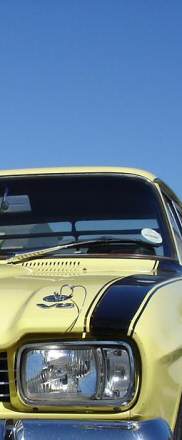
Bright Yellow or Peri Peri Red were officially the only colour options, but a handful of cars were produced in other colours including gold and mustard. The twin black stripes running either side of the bonnet and sweeping up the curve of the rear side windows and the chromed RoStyle wheels were the defining external features. In addition the car had Perana badges below the XL badges on the front fenders and V8 badges on the bonnet and boot. Most cars had a black boot lid. Many cars were equipped with the optional Perana louver on the back window.
All cars had a black interior and in the Basil Green tradition the interior was standard Capri XL except for an alloy spoked steering wheel.
The Capri Perana was priced at R4450 (approximately £2200 in 1970)
Towards the end of South African Ford Capri production Basil Green announced the R Pack Perana which was based on the four cylinder XLR shell, presumably because six cylinder shells were no longer available. The R Pack shown in adverts at the time had a flat bonnet and high back seats. The bonnet was painted black, and the car had different stripes. There is no evidence that these models were actually ever produced.